• • • THE WANDERER TTRPG SYSTEM • • •
Wanderer is a d100-based system designed to function in different types of settings with modular parts that can be included/excluded according to the story's/setting's need. Here you'll find a simple introduction to the system.If you want a more thorough walkthrough of the system, please refer to this document.
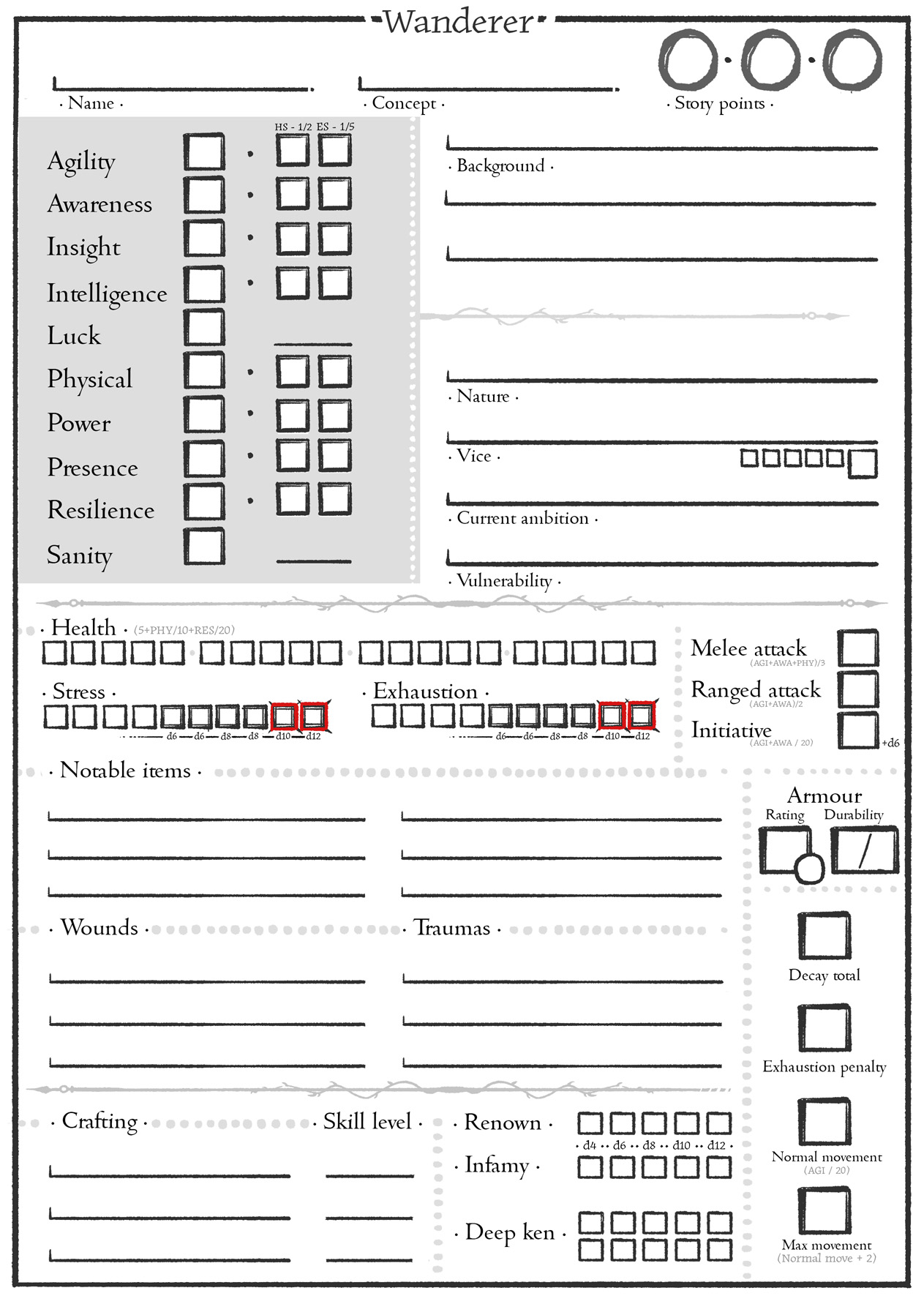
1. Name
Character name. No more, no less.
2. Concept
The core concept for the character. This forms half of the base that decides what sort of Skills the character might have developed in the past.
3. Story points
Story points are awarded each game session as well as when a character achieves something significant that connects to their Nature or Current ambition. Story points can be used to add elements to scenes, reroll a die or achieve an automatic success. The more Story points you use in one go, the more significantly you can change a scene.
4. Core stats
There are ten core stats: Agility, Awareness, Insight, Intelligence, Luck, Physical, Power, Presence, Resilience and Sanity. When you make a roll against these stats, you need to roll equal to or under your given stat. Rolling under half of your stat counts as a Hard Success and rolling under a fifth of your stat counts as an Extreme success.
If you are rolling for an action that is outside the character's experience (based on Background and Concept), you roll with disadvantage (roll twice, use the worse result). If the character is likely to have previous experience, you roll normally. But if a character has a defined Skill for this action, the roll is done with advantage (roll twice, use the better result).
Two additional die mechanics apply: Pushing rolls and Spending Luck.
• If you fail a roll, you can Push the roll. This means you can reroll at the risk of more severe consequenses if you fail. Before the reroll, GM prompts the player with a question such as "What are you afraid will happen if you fail?". The player's answer, as you can imagine, is what will come to pass if they fail. Succeeding a Pushed roll counts as it would for a normal roll.
• If you fail a roll can also choose to spend Luck points to improve your result. This means that any future Luck roll will use the adjusted Luck value. Luck points can't be used on Pushed rolls.
5. Background
The character's Background is the other half of the base that shapes what sort of Skills they might be decent at.
6. Nature
A character's Nature defines some core part of their character. Acting according to your Nature can lessen your Stress, and acting against your Nature can raise it. Significant achievements that fit your Nature can also award story points. Once per game session a player can also invoke their Nature to automatically succeed at an appropriate skill roll.
7. Vice
Each character has a Vice of some sort. This can be of varying severity, and a Vice can either lessen stress if indulged in or raise your Stress if you have to resist indulging in it. The more you indulge in your Vice, the more intense the craving becomes, making it harder to resist in the future.
8. Current ambition
The current goal that the character strives towards. Acting in a way that brings the character closer to the goal will lessen their Stress, while acting in a way that goes against the ambition will give the character more Stress.
9. Vulnerability
A Vulnerability is some thing or situation that the character is more sensitive towards than others. This means that being exposed to their Vulnerability (such as 'death' or 'failing my friends') causes them extra Stress.
10. Health
Health (calculated as 5+PHY/10+RES/20 for human characters) denotes the amount of damage and Decay a character can take before they suffer a Wound. If a character takes a Wound their Health is reset to full (except for any Decay they've accumulated). A character can take up to three Wounds, then they go into a dying state.
11. Stress
Stress is accumulated in many ways, denoting the psychological pressure the character is under. As it accumulated, it will start eroding the character's Sanity points - either at the end of a scene if the character isn't in danger, or every time their Stress reaches a new level if it's a dangerous situation (such as combat).
12. Exhaustion
Exhaustion is accumulated in different ways as the character pushes themself too hard. At a certain point this will start resulting in penalties which apply to ever other roll made.
13. Melee & Ranged attack
Melee and ranged attack values are used for attack rolls of different kinds. They are calculated as the average of Agility + Awareness + Physical and Agility + Awareness respectively. Hard/Extreme success rules apply here as well, with added bonuses depending on weapon used.
14. Initiative
Initiative is rolled (one d6 + character's initiative value) at the start of a challenge phase (such as combat). A character has to beat the collective enemy Initiative value to act before them, otherwise they will be acting afterwards.
15. Notable items
A place to note the most important items for quick reference.
16. Wounds
A character can accumulate up to three Wounds, after which they go into a dying state. Each consecutive Wound will be more severe, and each wound will mean a different type of penalty to the character. Wounds can be either completely healed or healed slightly, making them chronic. Chronic Wounds have lessened penalties and do not count towards the three wound limit.
17. Traumas
If a character is reduced to 0 Sanity points they receive a Trauma, depending on the context. When a character takes a Trauma, their Sanity points reset to half. A character can take up to three Traumas before they become too unstable to function properly. Healing Traumas is more difficult than healing Wounds and is done through play rather than mechanics.
18. Crafting
A character can have crafting skills in a number of different disciplines, at six different skill levels. Using low/medium/high quality materials they can craft new items or repair existing items.
19. Renown & Infamy
Renown and Infamy accrue during the course of the story and impact many social rolls either positively or negatively. A social roll that is affected by renown, for example, adds a d4-d12 die to the normal d100 Presence roll and subtracts the result on the renown die from the result of the d100 roll.
20. Deep ken
Sometimes you gain insight into things you should not know of. Raising this will end badly.
21. Armour
Armour is divided into Rating and Durability. Rating defines how much damage resistance a piece of armour offers, while Durability defines how much damage the armour can take before it breaks. The circle space is meant for noting down potential +/- modifiers to armour Rating such as from shields or equipment. The Durability space is meant for noting down [ Adjusted / Maximum ] Durability values.
22. Decay total
The cumulated Decay the character has accumulated. Decay is the umbrella term for all things such as cold, hunger, bleeding, thirst, disease, poison, etc. Decay lessens the effective health the character has.
23. Exhaustion penalty
The cumulative penalty received from Exhaustion. As a character accumulates Exhaustion, the penalty applied to their rolls grows higher and higher.
24. Normal movement
Normal movement is calculated as the character's Agility divided by 20, rounded downwards (minimum 1 movement). This defines how many hexes they can freely move in one round during challenge states (such as combat). One hex is ca 2m in diameter.
25. Max movement
Max movement is calculated as Normal movement + 2. Max movement denotes how far a character can move during one turn if they rush forward. Any action after using Max movement will have heavy penalties.

If you want a more thorough walkthrough of the system, please refer to this document.